

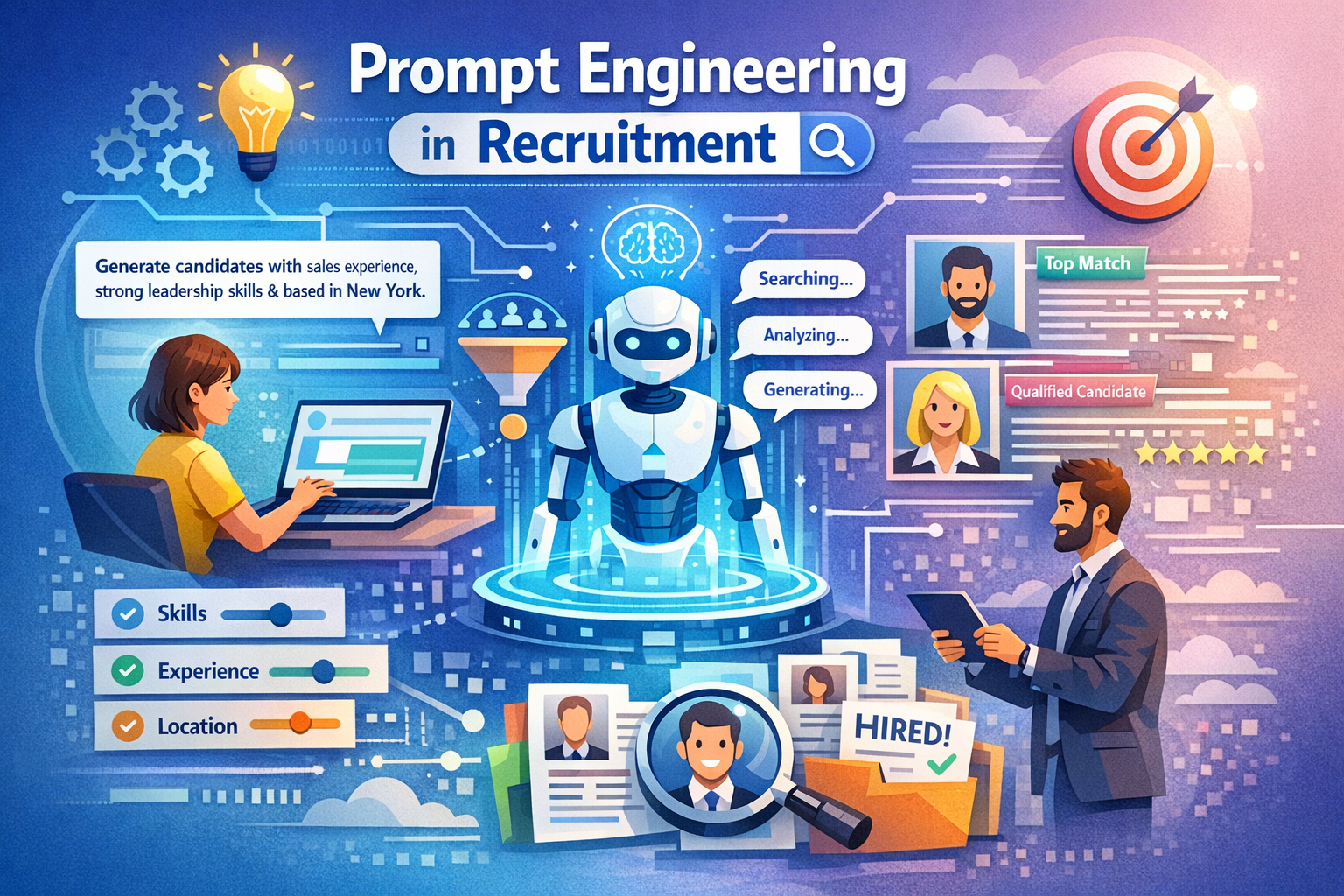
AI in recruitment isn’t about tools—it’s about control.
Most recruiters today use AI like a search engine. High-performing recruiters use it like a co-pilot with instructions.
The difference?
Prompt engineering.
1. Prompt Engineering = Decision Design
At an advanced level, prompt engineering is not just “asking better questions.”
It’s:
- Structuring hiring decisions
- Standardizing evaluation
- Reducing noise in recruitment workflows
Think of it this way:
❌ Traditional recruiting → Gut + scattered data
✅ AI-driven recruiting → Structured prompts + consistent logic
2. Deep Dive: How Prompt Engineering Maps to Hiring Stages
A. Sourcing (Top Funnel Intelligence)
What most do:
Find candidates for software engineer
What experts do:
Act as a tech recruiter hiring for a Series A startup. Identify candidate profiles with 3–5 years experience in backend systems, preferably from product companies. Suggest sourcing keywords, Boolean strings, and alternative job titles.
What this unlocks:
- Hidden talent pools
- Better search strings
- Platform-specific sourcing strategy
B. Resume Intelligence(Beyond Screening)
Instead of just filtering resumes, you can build evaluation systems.
Advanced Prompt:
You are a hiring panel for a fast-growing startup hiring a [ROLE].
Evaluate this resume across 5 dimensions: technical depth, ownership, impact, growth trajectory, and role fit.
Score each out of 10 with clear justification.
Prioritize candidates who have [YOUR PRIORITY – e.g., startup experience / client handling / scaling systems].
Highlight red flags, missing signals, and any assumptions made.
Finally, give a clear hire / no-hire recommendation with reasoning.
Output becomes:
- Comparable candidate scorecards
- Less bias
- Better hiring discussions
C. Interview Design (Structured Hiring)
AI can help you move from random questions → competency-based hiring.
Advanced Prompt:
Design a Product Manager interview loop with rounds covering intro, product thinking, execution, case study, team values, and final leadership discussion to assess both skills and ownership.
Evaluate competencies like problem framing, user empathy, prioritization, metrics thinking, decision-making, collaboration, and learning mindset through real-world and behavioral questions.
Use sample prompts such as improving a product experience, handling a failing feature, or resolving team conflicts to understand practical thinking.
Apply a consistent rubric scoring each dimension (1–10) with justification, and conclude with a clear hire/no-hire decision based on strengths, risks, and overall confidence.
Result:
- Consistent interviews
- Reduced interviewer bias
- Better candidate experience
D. Candidate Experience (Personalization at Scale)
Example Prompt:
Write a personalized outreach message referencing this candidate’s recent role, skills, and potential fit. Keep tone warm, non-salesy, and under 100 words.
Example – Hi [Name], I came across your recent work as a [Current Role] and was impressed by your experience in [key skill/project]. It looks like you’ve been building strong capabilities in [specific strength], which aligns closely with what we’re looking for in our Product team. I’d love to connect and learn more about what you enjoy working on and share a bit about what we’re building. No pressure—just a conversation to explore if there’s a potential fit.
You can also:
- Generate rejection emails with empathy
- Create follow-up nudges
- Build onboarding communication
E. Hiring Analytics (Decision Intelligence)
Prompt:
Share the dataset for precise insights, but here’s a quick framework: analyze funnel stages (applications → screening → interviews → offers → joins) to spot sharp drop-offs. High early drop-offs indicate poor sourcing or JD mismatch; mid-stage drops suggest interview or expectation gaps; offer declines point to compensation or delays.
Check time between stages—slow movement signals bottlenecks like recruiter bandwidth or interviewer availability. Compare sourcing channels to see which converts best.
Fix by refining JDs, standardizing interview rubrics, speeding up decisions, and aligning expectations early.
This turns AI into a recruitment analyst, not just a writing tool.
3. Advanced Prompt Engineering Techniques (Recruitment Edition)
A. Multi-Role Prompting
Make AI simulate a hiring panel:
Respond as a recruiter, hiring manager, and HRBP. Give each perspective on this candidate.From a recruiter’s perspective, the candidate presents a strong and relevant profile with clear communication and good alignment to the role, though a few areas need validation and expectations should be aligned early. From the hiring manager’s view, the candidate shows solid problem-solving ability and ownership, but would benefit from deeper evidence of execution in complex scenarios, indicating potential with some development needs. From an HRBP lens, the candidate appears collaborative with a positive learning mindset, and while there may be minor concerns around adaptability or handling pressure, they are likely to fit well within the team culture.
B. Constraint Layering
Force precision:
- “Only use bullet points”
- “Limit to 3 insights”
- “Avoid generic phrases”
C. Iterative Refinement
Don’t settle for first output:
Refine the shortlist by prioritizing candidates who demonstrate clear ownership and measurable impact rather than just participation. Focus on profiles where individuals have led initiatives end-to-end, made key decisions, and can quantify outcomes such as revenue growth, user adoption, cost savings, or efficiency improvements. Deprioritize candidates with vague contributions or team-based achievements without defined roles. Look for strong signals like accountability for results, ability to drive projects independently, and evidence of influencing stakeholders. This stricter lens ensures the shortlist highlights candidates who not only contributed but truly owned and moved the needle.
D. Context Injection
Garbage in → garbage out
Provide:
- Job Description:
- Be specific about responsibilities, success metrics, and must-have vs good-to-have skills. Instead of generic tasks, define what success looks like in the first 3–6 months.
- Company Stage:
- Mention whether you’re a startup, scaling, or enterprise. This sets expectations—early-stage needs ownership and ambiguity handling, while mature companies value specialization and process.
- Hiring Urgency:
- Clarify if the role is critical (immediate joiner, fast decisions) or planned hiring (flexible timeline). This impacts screening strictness and interview speed.
- Team Structure:
- Explain who the candidate will work with—PMs, engineers, designers, reporting manager, and team size. This helps assess collaboration fit and stakeholder complexity.
E. Evaluation Framework Prompts
Create reusable systems:
The hiring scorecard is structured to capture both candidate details and a consistent evaluation across key sales competencies. It includes fields such as candidate name, role, interview stage, interviewer, and date, followed by core scoring areas: prospecting, sales skills, communication, ownership, customer understanding, data orientation, and culture fit—each rated on a scale of 1 to 10. A total score is automatically calculated by summing these dimensions, ensuring objective comparison across candidates. The template also includes sections for recommendation (hire/hold/no hire), confidence level, and detailed notes to capture evidence-based observations. Supported by a separate evaluation guide defining what each competency entails, this format ensures structured, unbiased decision-making while allowing flexibility to adapt scoring emphasis based on the specific sales role.
4. Tool-Level Differences: Not All AI Thinks the Same
Understanding how each AI behaves is where most recruiters gain an edge.
🔹 ChatGPT — The Structured Thinker
Core Strengths:
- Step-by-step reasoning
- Structured outputs (tables, frameworks, scoring)
- Strong for multi-stage workflows
Best Use Cases:
- Resume scoring systems
- Interview frameworks
- Hiring playbooks
- Prompt templates
Features to Leverage:
- Memory (context retention within conversation)
- Custom instructions (set recruiting style)
- Multi-step prompting (chain workflows)
Ideal Prompt Style:
- Clear instructions
- Defined output format
- Step-based tasks
🔹 Claude — The Context Master
Core Strengths:
- Handles very long inputs (multiple resumes, long JDs)
- More natural, human-like writing
- Better nuance detection
Best Use Cases:
- Bulk resume analysis
- Employer branding content
- Candidate communication
- Policy drafting
Features to Leverage:
- Large context window (analyze multiple documents at once)
- Safer, more balanced tone
Ideal Prompt Style:
- Conversational
- Context-heavy
- Less rigid formatting
🔹 Gemini — The Research Engine
Core Strengths:
- Real-time information
- Integration with search + Google ecosystem
- Trend analysis
Best Use Cases:
- Salary benchmarking
- Market research
- Competitor hiring analysis
- Industry insights
Features to Leverage:
- Live data access
- Workspace integration (Docs, Sheets)
Ideal Prompt Style:
- Research-oriented
- Comparative queries
- Insight-driven
5. Strategic Comparison (Expanded)
| Capability | ChatGPT | Claude | Gemini |
|---|---|---|---|
| Resume Screening | ⭐⭐⭐⭐⭐ | ⭐⭐⭐⭐ | ⭐⭐⭐ |
| Bulk Resume Analysis | ⭐⭐⭐ | ⭐⭐⭐⭐⭐ | ⭐⭐⭐ |
| Outreach Writing | ⭐⭐⭐⭐ | ⭐⭐⭐⭐⭐ | ⭐⭐⭐ |
| Hiring Frameworks | ⭐⭐⭐⭐⭐ | ⭐⭐⭐⭐ | ⭐⭐⭐ |
| Market Research | ⭐⭐⭐ | ⭐⭐⭐ | ⭐⭐⭐⭐⭐ |
| Long Context Handling | ⭐⭐⭐ | ⭐⭐⭐⭐⭐ | ⭐⭐⭐⭐ |
| Structured Decision Making | ⭐⭐⭐⭐⭐ | ⭐⭐⭐⭐ | ⭐⭐⭐ |
6. Building a Recruitment AI Stack (Practical View)
Top recruiters don’t use one tool—they build a stack:
- Use ChatGPT for:
- Screening logic
- Frameworks
- structured outputs
- Use Claude for:
- Resume deep dives
- Communication
- documentation
- Use Gemini for:
- Market intelligence
- hiring trends
7. Risks & Responsible Use
Prompt engineering also requires responsibility.
Key Risks:
- Bias in prompts → biased hiring
- Over-reliance on AI decisions
- Data privacy concerns
Best Practices:
- Never upload sensitive candidate data blindly
- Use AI for assistive decisions, not final decisions
- Regularly audit outputs
8. The Real Shift: Recruiters → AI Operators
The future recruiter will:
- Design hiring systems
- Train AI with prompts
- Interpret AI outputs
Not just:
- Screen resumes
- Schedule interviews
9. Final Insight
Prompt engineering is not about talking to AI.
It’s about thinking clearly about hiring problems.
If you can:
- Define what “good candidate” means
- Structure evaluation
- Communicate it precisely
AI becomes your force multiplier.