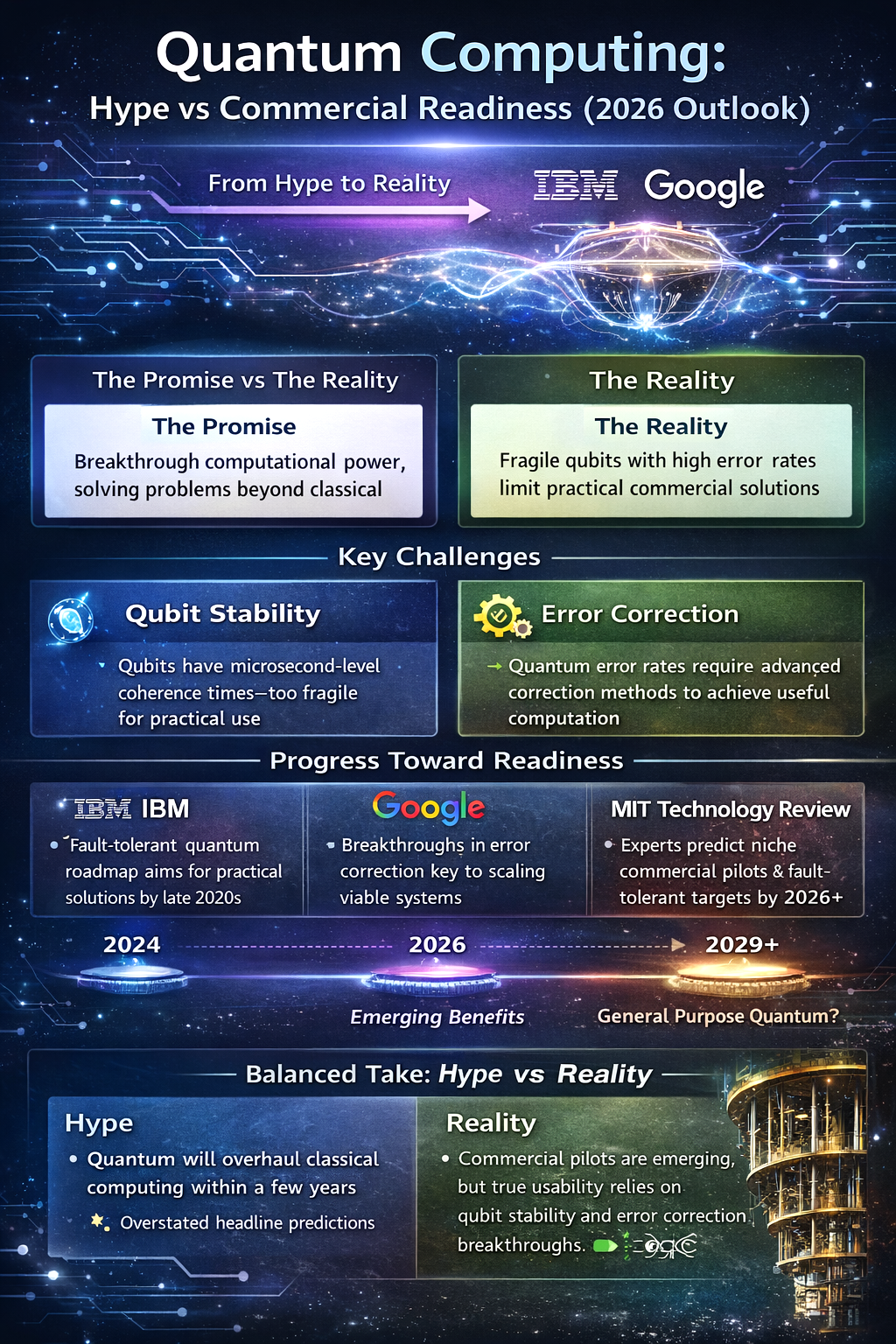
Quantum computing has long been touted as the next frontier in computation. From theoretical physics to commercial ambitions, it’s both one of the most hyped and most technically challenging technologies of the 21st century. But as we move deeper into 2026, where does the field actually stand — particularly in terms of commercial readiness? This article separates hype from reality, drawing on recent developments from major industry players—IBM, Google—and the broader research community.
1. What Is Quantum Computing’s Promise — and Reality?
Quantum computers use quantum bits (qubits), which unlike classical bits can represent both 0 and 1 simultaneously through superposition. If harnessed effectively, qubits could solve certain classes of problems far faster than classical computers. But practical quantum computing is held back by two crucial challenges:
- Qubit instability (decoherence): Qubits are extremely fragile and lose their quantum state due to environmental noise. This makes sustained computation difficult.
- Error rates and error correction: Quantum operations are prone to errors. Developing techniques to correct these without exploding the number of qubits required has been a decades-long hurdle.
Together these factors explain why practical, widely useful quantum computers are still in development long after the first experimental devices were built.
2. The Hype: Bold Timelines and Breakthrough Claims
It’s easy to get carried away with claims from the media and investors about quantum “supremacy” or “revolutionary breakthroughs.” Headlines suggesting quantum will make classical computers obsolete in a few years often overlook the technical requirements for practical use.
For decades, the mainstream narrative revolved around Noisy Intermediate-Scale Quantum (NISQ) systems — prototypes with tens or a few hundred qubits that demonstrate potential but cannot run long, error-free computations. Only when systems reach fault tolerance—meaning they can correct errors on the fly—can they reliably outperform classical machines on real-world problems.
3. Qubit Stability: The Fragility Problem
One of the biggest barriers is qubit coherence — how long a qubit holds its quantum state. Current systems measure coherence in microseconds, far shorter than what large, practical algorithms require. Improvements in materials, design, and isolation are steadily extending these times, but the technology remains easily disrupted by environmental noise.
Recent experiments by Google demonstrated below-threshold error correction where adding more qubits actually reduces error rates as systems scale — a critical milestone after decades of struggle. This indicates true progress toward stability, even though absolute error rates are still above what large industrial applications demand.
4. Error Correction: A Technical Turning Point
Error correction is the linchpin of scaling quantum computers. Without effective quantum error correction (QEC), qubits lose information faster than computations can complete.
Google’s Breakthrough
Google’s Willow quantum system demonstrated the so-called below threshold behavior: error suppression improved as arrays of qubits grew, a necessary condition for meaningful error correction.
IBM’s Approach
IBM has pursued both traditional and alternative QEC strategies. Their quantum low-density parity-check (qLDPC) codes can encode logical qubits using dramatically fewer physical qubits than older methods, representing an important step toward fault-tolerant systems.
Why It Matters
Most estimates (including those by MIT Technology Review-level observers of the ecosystem) suggest error correction progress is the defining threshold between lab experiments and real quantum advantage. As error rates fall below certain thresholds, computation becomes stable enough for commercial applications.
5. Commercial Pilots & Practical Use Cases
While general-purpose fault-tolerant quantum computers are still emerging, early commercial pilots are already happening in niche areas:
- Optimization problems: Some quantum processors now show clear practical advantages in optimization tasks (e.g., logistics, scheduling) over classical approaches — with orders-of-magnitude speedups in test cases.
- Quantum chemistry simulations: Quantum hardware is being used to model complex molecular interactions that are extremely costly for classical simulation, potentially accelerating drug discovery.
- Cloud access: Both IBM and Google offer quantum services via cloud platforms, allowing businesses and researchers to experiment with quantum algorithms without owning hardware.
These pilots represent the first commercially relevant outcomes of quantum technology — but they are far removed from broad business deployment.
6. Commercial Readiness: Where Are We in 2026?
IBM’s Roadmap
IBM’s roadmap aims for fault-tolerant systems by around 2029, with several intermediate processors (such as Nighthawk and Loon) demonstrating key technologies required for that goal. One early test processor, Nighthawk, already integrates more qubits and enhanced connectivity, showing progress year-over-year.
Google’s Strategy
Google’s Quantum AI division focuses heavily on error-corrected logical qubits and fine-tuned coherence times. The success of systems like Willow suggests a viable path toward machines capable of real quantum advantage — but full deployment at scale still lies ahead.
Industry Consensus
Experts agree that quantum computing is real and advancing, but that general-purpose, fault-tolerant quantum systems are still several years away from widespread commercial deployment in mainstream industries.
This means:
- Specific pilots and proofs of advantage are happening now.
- Scaled, versatile commercial quantum systems will likely emerge late in this decade or beyond.
- Broad adoption across sectors depends on further breakthroughs in stability, error correction, and cost reduction.
7. Hype vs Reality: A Balanced Take
Hype: Headlines often imply quantum computers will supplant classical computing within a few years.
Reality: Quantum computing is progressing steadily, but true commercial readiness hinges on unresolved hardware and error-correction challenges — not marketing narratives.
The key milestones to watch in 2026 and beyond include:
- Demonstrations of reliable logical qubits with low error rates.
- Extended coherence times that allow deeper quantum circuits.
- Commercial pilots that solve real business problems better than classical alternatives.
The work of IBM and Google illustrates that the industry’s progress is now more than theoretical promise — but also not yet complete delivery.
Conclusion: 2026 Outlook
Quantum computing in 2026 stands at an inflection point. Progress in qubit stability and error correction is changing the narrative: from speculative science to narrow commercial value. Key players are targeting fault tolerance on meaningful timelines, and niche applications are emerging that already outperform classical approaches for select problems.
As the technology matures through 2026 and into 2029 and beyond, the focus will likely shift from can we build quantum computers to how do we integrate them into practical business workflows. That’s where real commercial readiness will be defined — beyond the hype and into transformative impact.
About the Author
About the Author
Ashish Kumar Bhowmick is the founder of AshimHub, a platform dedicated to exploring technology, AI tools, gadgets, and emerging digital trends. With a strong passion for simplifying complex technologies, he creates practical guides, product comparisons, and tutorials that help readers make smarter technology decisions.
Alongside his work in technology content, Ashish has professional experience in talent acquisition and recruitment coaching. He has supported organizations and professionals in improving hiring strategies, building stronger recruitment processes, and developing career growth pathways in competitive job markets.
Through AshimHub, Ashish combines technology insights with professional expertise, delivering valuable content that empowers both tech enthusiasts and career-focused readers. His mission is to make technology and professional development more accessible, practical, and easy to understand for everyday users.
Connect with him on LinkedIn:
https://www.linkedin.com/in/ashish-bhowmick-42961311/