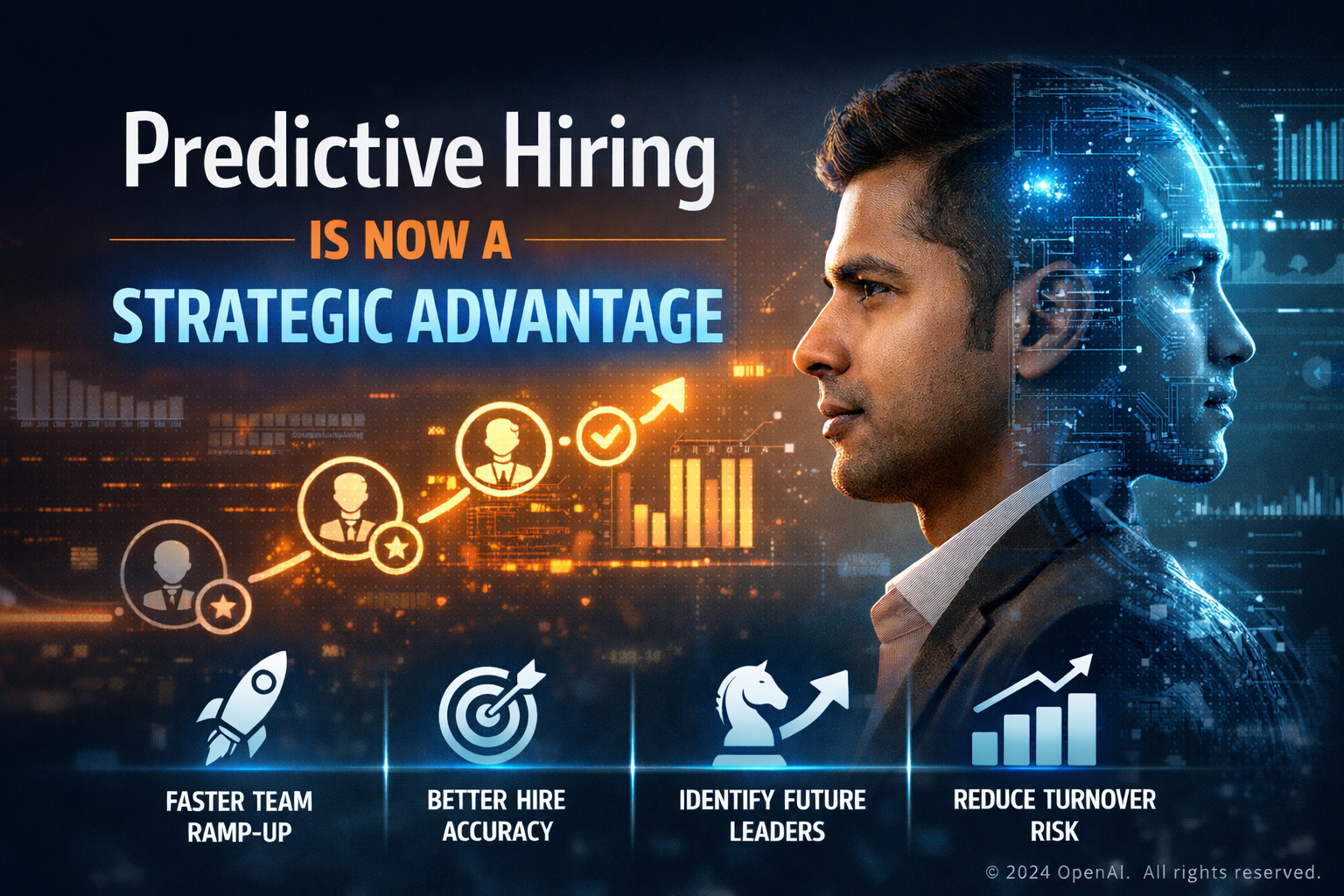
Recruitment is undergoing a structural shift.
For decades, hiring decisions were largely driven by instinct, experience, and subjective judgment. Recruiters relied on resumes, interviews, and informal conversations about “cultural fit.” These methods sometimes produced strong hires, but they also introduced inconsistency and bias into the decision-making process.
In many organizations, hiring outcomes were rarely measured beyond the initial onboarding phase. Whether a candidate ultimately became a high-performing employee or left the company within a year often had little influence on how future hiring decisions were made.
Today, predictive hiring is beginning to redefine how organizations evaluate talent. Instead of relying primarily on intuition, many companies are turning to data analysis and machine learning models to support recruitment decisions.
The key question is gradually shifting from:
“Do we like this candidate?”
to
“What does the available data suggest about this candidate’s potential performance and retention?”
This shift reflects a broader trend toward evidence-based decision-making in workforce management.
What Is Predictive Hiring?
Predictive hiring refers to the use of data analytics and machine learning techniques to forecast how well a candidate may perform in a specific role.
Rather than evaluating candidates solely based on past experience or educational background, predictive hiring systems analyze patterns across large datasets that include previous hires and their outcomes.
These systems may evaluate factors such as:
- Past job performance metrics
- Career progression patterns
- Behavioral assessment results
- Skills and competency profiles
- Historical retention data
Using this information, predictive models generate probability-based insights about candidates.
For example, a model may estimate:
- Likelihood of strong job performance
- Probability of long-term retention
- Estimated time required to reach full productivity
- Compatibility with the organization’s working environment
These predictions do not replace human decision-making. Instead, they provide additional information that can support recruiters and hiring managers when evaluating candidates.
Why Gut-Based Hiring Is Failing
Traditional recruitment processes often face structural challenges that reduce hiring accuracy. Three common issues frequently appear in many organizations.
1. Cognitive Bias
Human decision-making is naturally influenced by psychological biases.
Interviewers may favor candidates who share similar backgrounds, personalities, or communication styles. While this may feel intuitive during interviews, it does not necessarily correlate with job performance.
Bias can also appear in subtle forms such as:
- Preference for familiar universities
- Favoring extroverted communication styles
- Overvaluing confidence during interviews
These tendencies can unintentionally limit diversity and overlook qualified candidates.
2. Inconsistent Evaluation
Another challenge is the lack of standardized evaluation criteria.
Different interviewers may prioritize different qualities. One manager may value technical expertise, while another may emphasize personality or communication style.
When evaluation standards vary between interviewers, the hiring process becomes less reliable.
Structured data analysis can help reduce this inconsistency by identifying objective indicators of success.
3. Poor Feedback Loops
In many organizations, hiring outcomes are rarely analyzed systematically.
For example:
- Which hiring channels produced the best employees?
- Which interview assessments predicted long-term success?
- Which skills correlated with top performers?
Without tracking these relationships, organizations miss opportunities to improve their hiring strategies.
Predictive hiring attempts to close this feedback loop by analyzing long-term workforce data.
How Predictive Hiring Works
Predictive hiring systems combine several types of data to generate insights about candidates.
Although specific implementations vary, most systems include four key components.
1. Historical Performance Data
The foundation of predictive hiring is historical workforce information.
This may include:
- employee performance evaluations
- promotion timelines
- tenure and retention patterns
- training completion data
By analyzing these datasets, organizations can identify characteristics that frequently appear among high-performing employees.
2. Skills & Competency Mapping
Once performance data is analyzed, predictive models attempt to identify which skills correlate most strongly with success in a particular role.
For example:
- analytical ability for data roles
- communication skills for customer-facing roles
- adaptability in rapidly changing environments
This mapping allows recruiters to focus on capabilities that truly matter for performance rather than relying on assumptions.
3. Behavioral & Assessment Data
Many organizations supplement resume information with structured assessments.
These may include:
- cognitive ability tests
- situational judgment exercises
- structured behavioral interviews
These assessments generate standardized data that predictive models can analyze more effectively than unstructured interview notes.
4. Machine Learning Models
Machine learning algorithms analyze patterns across the combined datasets.
These models identify relationships between candidate attributes and real-world outcomes such as job performance or retention.
The result is typically a probability-based score rather than a definitive recommendation.
For example:
Candidate A — 78% predicted performance alignment
Candidate B — 52% predicted performance alignment
Recruiters still make the final decision, but the model provides additional insight.
The Measurable Impact
Organizations that adopt predictive hiring frameworks often report several operational improvements.
- Reduced time-to-hire – Predictive models help prioritize candidates who are statistically more likely to succeed. This reduces time spent evaluating less suitable candidates.
- Lower early attrition rates – By analyzing patterns associated with past departures, predictive systems can help identify candidates who are more likely to remain with the company longer.
- Improved quality-of-hire – Better hiring decisions can lead to improved productivity, stronger team performance, and higher employee engagement.Predictive hiring attempts to improve the signal-to-noise ratio in candidate evaluation.
- More consistent evaluation standards – Structured data reduces variability between interviewers and hiring managers.Candidates are assessed based on comparable metrics rather than subjective impressions alone.
- Higher diversity outcomes (when bias is properly controlled)
Predictive hiring improves signal-to-noise ratio in candidate evaluation.
Predictive Hiring vs AI Resume Screening
Predictive hiring is often confused with automated resume screening, but the two approaches serve different purposes.
Resume screening primarily focuses on filtering candidates based on predefined criteria such as education, experience, or keywords.
Predictive hiring, on the other hand, attempts to forecast future outcomes using multiple data variables.
In simple terms:
Resume screening = filtering
Predictive hiring = forecasting
Screening removes candidates who do not meet requirements.
Predictive models attempt to estimate which candidates are most likely to succeed.
Practical & Ethical Considerations
Despite its advantages, predictive hiring raises important ethical and operational questions.
Key risks include:
- Historical bias embedded in past hiring data
- Over-reliance on algorithmic outputs
- Lack of transparency in scoring models
- Regulatory compliance challenges
Responsible predictive hiring requires:
- Bias audits
- Transparent evaluation criteria
- Human oversight
- Continuous model recalibration
Data should inform judgment — not replace accountability.
The Shift from Recruiter Intuition to Talent Intelligence
Predictive hiring does not eliminate the need for recruiters. Instead, it changes the nature of their work.
Traditionally, recruiters often focused on tasks such as:
- reviewing resumes
- coordinating interviews
- making intuition-based recommendations
As predictive tools become more common, the recruiter’s role is evolving toward:
- interpreting hiring data
- advising hiring managers
- designing effective recruitment strategies
- improving workforce planning
This transformation shifts recruitment toward a more strategic and analytical function.
Is Predictive Hiring the Future?
The broader shift taking place in recruitment is philosophical as well as technological.
Hiring decisions are gradually moving from:
Subjective evaluation → Statistical probability
Opinion → Evidence
Experience → Data-supported intelligence
Organizations that adopt predictive hiring responsibly may gain advantages in talent acquisition and workforce planning.
However, successful implementation requires careful oversight, ethical data practices, and continuous model improvement.
Predictive hiring should be viewed as a tool that enhances human judgment rather than replacing it.
In the coming years, the most effective hiring processes will likely combine structured data analysis with experienced human evaluation.
Recruitment will still involve interviews and personal interaction—but increasingly supported by insights derived from workforce data.
The future of hiring may not be about who interviews best.
It may be about who makes the most informed decisions.
About the Author
Ashish Kumar Bhowmick is the founder of AshimHub, a platform dedicated to exploring technology, AI tools, gadgets, and emerging digital trends. With a strong passion for simplifying complex technologies, he creates practical guides, product comparisons, and tutorials that help readers make smarter technology decisions.
Alongside his work in technology content, Ashish has professional experience in talent acquisition and recruitment coaching. He has supported organizations and professionals in improving hiring strategies, building stronger recruitment processes, and developing career growth pathways in competitive job markets.
Through AshimHub, Ashish combines technology insights with professional expertise, delivering valuable content that empowers both tech enthusiasts and career-focused readers. His mission is to make technology and professional development more accessible, practical, and easy to understand for everyday users.
Connect with him on LinkedIn:
https://www.linkedin.com/in/ashish-bhowmick-42961311/