Introduction
Hiring does not happen in isolation.
Every recruitment decision—whether it’s opening a new role, delaying a hire, or increasing salary budgets—is influenced by forces beyond the organization. These forces are known as market trends.
For freshers and even early-stage recruiters, hiring may appear to be driven solely by internal needs. A team requires talent, a role is approved, and recruitment begins.
But in reality, hiring decisions are shaped by a dynamic external environment that includes economic conditions, industry shifts, talent availability, and technological changes.
Understanding how market trends impact hiring is not just useful—it is essential. It enables recruiters to move from reactive execution to strategic contribution.
What Are Market Trends in Hiring?
Market trends refer to patterns and changes in the external environment that influence talent demand and supply.
These trends can include:
- Economic growth or slowdown
- Industry expansion or contraction
- Changes in skill demand
- Salary benchmarks and compensation trends
- Technological advancements
- Workforce expectations and behavior
Recruiters who understand these trends can anticipate hiring needs instead of simply reacting to them.
Why Market Trends Matter in Recruitment
Ignoring market trends leads to poor hiring decisions.
For example:
- Offering outdated salary ranges can result in candidate drop-offs
- Hiring aggressively during uncertain markets can lead to layoffs later
- Delaying hiring during growth phases can slow business expansion
Market awareness helps recruiters:
- Align hiring with business strategy
- Set realistic expectations with stakeholders
- Improve hiring efficiency
- Enhance candidate experience
It transforms recruitment into a business-aligned function, not just a support role.
Key Market Trends That Influence Hiring
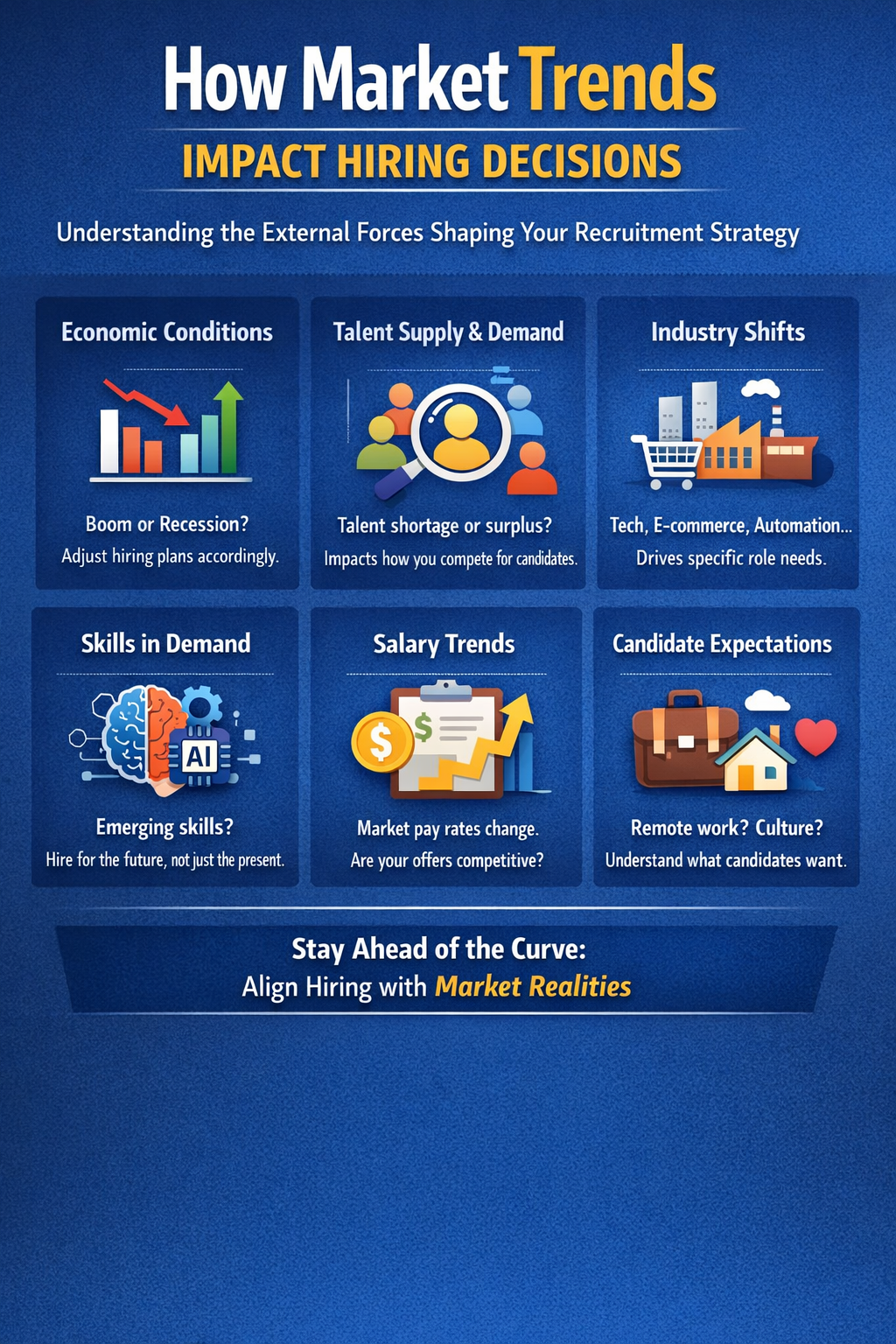
1. Economic Conditions
The overall economic environment has a direct impact on hiring.
During Economic Growth:
- Companies expand teams
- Hiring budgets increase
- Demand for talent rises
- Candidates have more options
During Economic Slowdown:
- Hiring slows down or freezes
- Budgets become tighter
- Employers become more selective
Real-World Insight
Recruiters must adjust strategies based on economic cycles.
In a booming market, speed and competitive offers matter.
In a slow market, quality and cost efficiency take priority.
2. Talent Supply and Demand
One of the most critical factors in hiring is the availability of talent.
High Demand, Low Supply:
- Increased competition among companies
- Higher salaries
- Longer time-to-hire
Low Demand, High Supply:
- More applications
- Easier hiring
- Lower salary pressure
Example
Roles like data science, AI, and cybersecurity often face talent shortages, making sourcing more complex and competitive.
3. Industry Trends
Each industry experiences its own cycles.
For example:
- Tech industry growth → Increased hiring for developers
- E-commerce expansion → Demand for logistics and operations roles
- Automation → Reduced need for repetitive roles
Recruiters must understand the specific trends affecting their industry to align hiring strategies effectively.
4. Skill Evolution
The skills required in the market are constantly evolving.
New technologies create demand for new skills, while older skills may become less relevant.
Examples:
- Rise of AI → Demand for machine learning skills
- Digital transformation → Need for cloud and data skills
- Automation → Focus on analytical and strategic roles
Key Insight
Hiring based only on past requirements can lead to outdated talent decisions.
Recruiters must focus on future-ready skills, not just current needs.
5. Compensation and Salary Trends
Market trends significantly impact salary expectations.
If compensation is not aligned with the market:
- Candidates decline offers
- Drop-offs increase
- Hiring cycles become longer
Recruiters must stay updated on:
- Industry salary benchmarks
- Competitor compensation strategies
- Candidate expectations
6. Candidate Behavior and Expectations
Today’s candidates think differently compared to the past.
They prioritize:
- Work-life balance
- Remote or hybrid work options
- Career growth opportunities
- Company culture
Real-World Impact
Companies that fail to adapt to these expectations struggle to attract and retain talent.
Recruitment is no longer just about offering a job—it’s about offering an experience and opportunity.
How Market Trends Shape Hiring Decisions
1. Role Prioritization
Market conditions influence which roles are prioritized.
- High-growth phases → Expansion roles
- Uncertain markets → Critical and revenue-generating roles
2. Hiring Speed
- Competitive markets → Faster hiring decisions
- Stable markets → More structured and slower processes
3. Candidate Selection Criteria
In competitive markets, companies may:
- Hire for potential
- Compromise on certain skills
In slow markets, companies may:
- Be more selective
- Focus on exact matches
4. Budget Allocation
Market trends determine:
- Salary ranges
- Hiring budgets
- Investment in recruitment tools
5. Workforce Planning
Organizations adjust hiring plans based on:
- Market demand
- Business forecasts
- Industry outlook
Common Mistakes Recruiters Make
❌ Ignoring Market Reality
Relying only on internal expectations without considering external factors
❌ Using Outdated Salary Benchmarks
Leads to offer rejections and candidate drop-offs
❌ Overestimating Talent Availability
Assuming candidates are easy to find when the market says otherwise
❌ Not Adapting Hiring Strategy
Using the same approach regardless of market conditions
How Recruiters Can Stay Updated
To make better hiring decisions, recruiters must stay informed.
Practical Steps:
- Follow industry reports and hiring trends
- Analyze competitor hiring patterns
- Stay active on professional platforms
- Engage with candidates to understand expectations
- Track internal hiring data and outcomes
Consistency in learning leads to better judgment.
The Strategic Advantage
Recruiters who understand market trends:
- Set realistic expectations with stakeholders
- Improve hiring success rates
- Reduce time-to-hire
- Enhance candidate experience
- Build credibility within the organization
They move from:
Process Executors → Strategic Talent Advisors
Final Thoughts
Hiring decisions are not just internal choices—they are responses to external realities.
Market trends shape:
- What roles are needed
- How quickly they must be filled
- What candidates expect
- How organizations compete for talent
Recruiters who ignore these trends remain reactive.
Those who understand them become strategic.
Conclusion
The future of recruitment belongs to those who can combine:
- Data
- Market awareness
- Human judgment
Understanding market trends is not an advanced skill—it is a foundational one.
For freshers, developing this awareness early can significantly accelerate career growth and improve hiring effectiveness.
🚀 Learn Real-World Recruitment
At AshimHub, we focus on helping freshers understand how hiring works beyond theory.
Our structured coaching helps you:
✔ Understand market-driven hiring
✔ Build strategic recruitment skills
✔ Handle real-world hiring challenges
If you want to build a strong foundation in recruitment, start learning how the market actually influences hiring.