

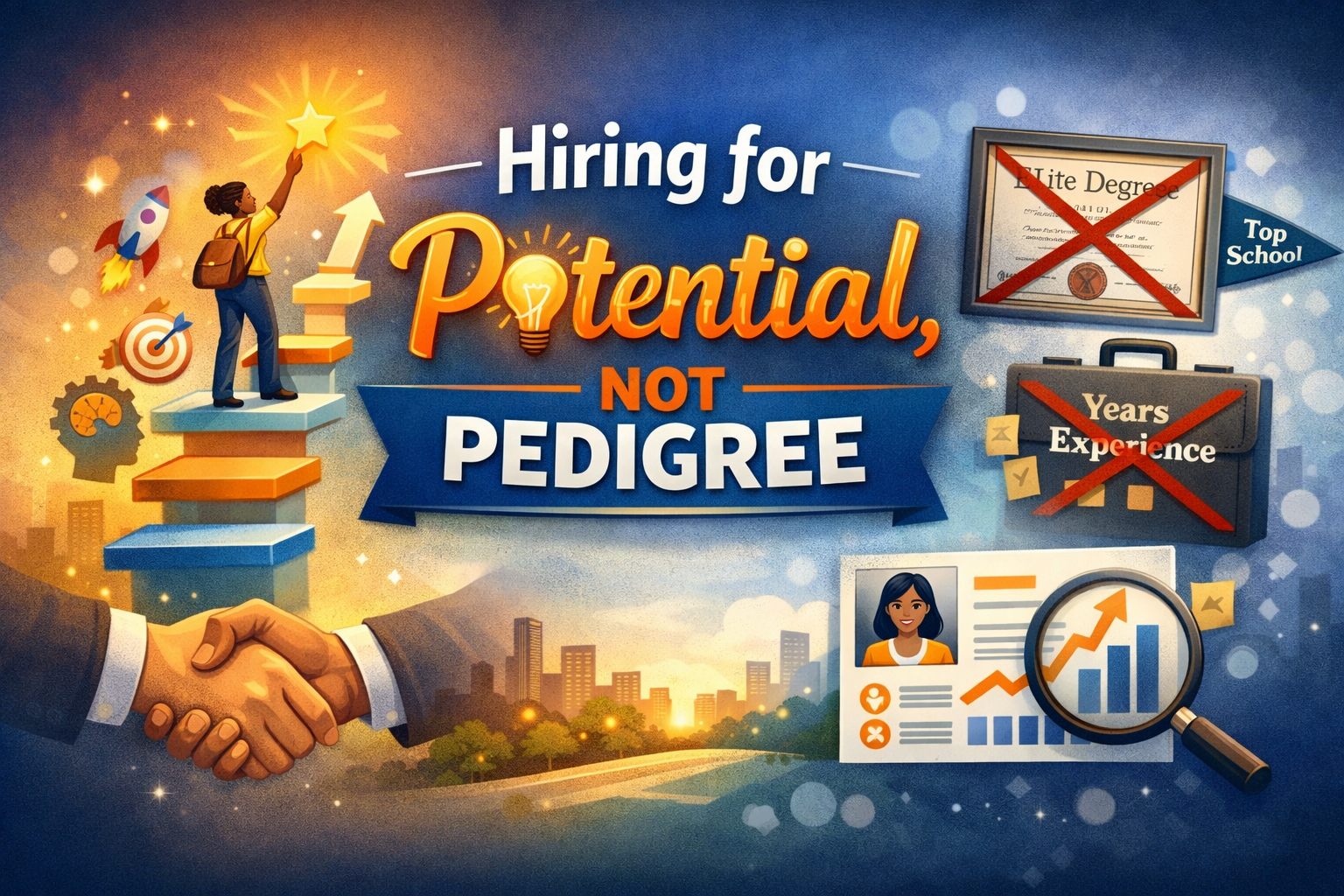
In today’s fast-changing talent landscape, the traditional markers of “quality hires” — elite colleges, big-brand employers, and polished resumes — are losing their predictive power. What truly differentiates high-performing organizations is not where their people come from, but what they are capable of becoming.
Hiring for potential, not pedigree is no longer a progressive idea — it’s a competitive necessity.
Why Pedigree Is Losing Relevance
For decades, hiring managers leaned on pedigree as a shortcut for quality. A top-tier degree or a well-known company on a resume signaled competence, discipline, and intelligence.
But this approach has three major flaws:
1. It overlooks hidden talent
Some of the most capable individuals never had access to elite institutions or opportunities. Pedigree-based hiring systematically filters them out.
2. It rewards privilege over capability
Pedigree often reflects access — not ability. Organizations risk reinforcing bias rather than building meritocratic teams.
3. It fails in dynamic environments
In a world driven by AI, automation, and constant disruption, past credentials are less valuable than adaptability and learning agility.
What Does “Hiring for Potential” Actually Mean?
Hiring for potential is about evaluating a candidate’s future capability, not just past achievements. It focuses on traits that predict long-term success, such as:
- Learning agility – How quickly can they acquire new skills?
- Problem-solving ability – Can they think critically in unfamiliar situations?
- Resilience – How do they handle setbacks and ambiguity?
- Curiosity – Do they seek to understand beyond surface-level tasks?
- Growth mindset – Are they open to feedback and continuous improvement?
These qualities are far more valuable than a brand name on a resume.
The Business Case: Why It Works
Organizations that prioritize potential see tangible benefits:
Stronger innovation
Diverse thinking leads to better problem-solving and creativity.
Higher retention
Employees hired for growth tend to stay longer when given development opportunities.
Better ROI on hiring
Instead of overpaying for “ready-made” talent, companies build capability internally.
Future-ready workforce
Potential-based hiring creates teams that evolve with the business.
How to Shift from Pedigree to Potential
Making this shift requires intentional changes in hiring strategy:
1. Redefine Job Requirements
Stop over-indexing on degrees, years of experience, or specific company backgrounds. Focus on skills, competencies, and outcomes.
Old mindset:
“Must be from Tier-1 college with 5+ years at top firms”
New mindset:
“Must demonstrate strong analytical thinking and ability to solve real-world problems”
2. Use Skill-Based Assessments
Replace resume filtering with practical evaluations:
- Case studies
- Work simulations
- Portfolio reviews
- Real-world problem-solving tasks
These reveal actual capability, not just credentials.
3. Structure Interviews Around Potential Signals
Ask questions that uncover thinking patterns, not rehearsed answers:
- “Tell me about a time you learned something completely new under pressure.”
- “How do you approach a problem you’ve never seen before?”
- “What’s a failure that changed how you work?”
Focus on how they think, not just what they’ve done.
4. Train Hiring Managers to Spot Potential
Most hiring biases are unconscious. Equip interviewers to recognize:
- Transferable skills
- Non-linear career growth
- Self-driven learning
- Adaptability over experience
Without this, even the best hiring frameworks fail.
5. Build Internal Growth Pathways
Hiring for potential only works if you invest in development:
- Structured onboarding
- Learning programs
- Mentorship
- Clear career progression
Potential without opportunity leads to disengagement.
Common Mistakes to Avoid
1. Confusing potential with guesswork
Potential must be assessed through structured methods, not gut feeling.
2. Ignoring baseline competence
Potential doesn’t mean compromising on foundational skills.
3. Hiring “cheap talent” under the label of potential
This approach is about long-term value, not cost-cutting.
4. Failing to align leadership
If leadership still values pedigree, change won’t stick.
The Role of AI in Potential-Based Hiring
AI is accelerating this shift by enabling:
- Skill-based matching over keyword-based resumes
- Behavioral analysis during assessments
- Predictive insights on candidate success
But technology alone isn’t enough. It must be paired with the right hiring philosophy.
Final Thoughts
The best organizations don’t hire the most impressive resumes — they build the most capable people.
Pedigree may open doors, but potential builds the future.
If your hiring strategy still prioritizes where someone has been over where they can go, you’re not just missing talent — you’re limiting your organization’s growth.
About AshimHub
At AshimHub, we believe the future of hiring lies in skills, potential, and intelligent decision-making powered by AI. Our mission is to help professionals and organizations move beyond outdated hiring filters and unlock real capability.
Want to build a smarter hiring strategy?
Explore more insights, tools, and AI-powered guidance at AshimHub.