

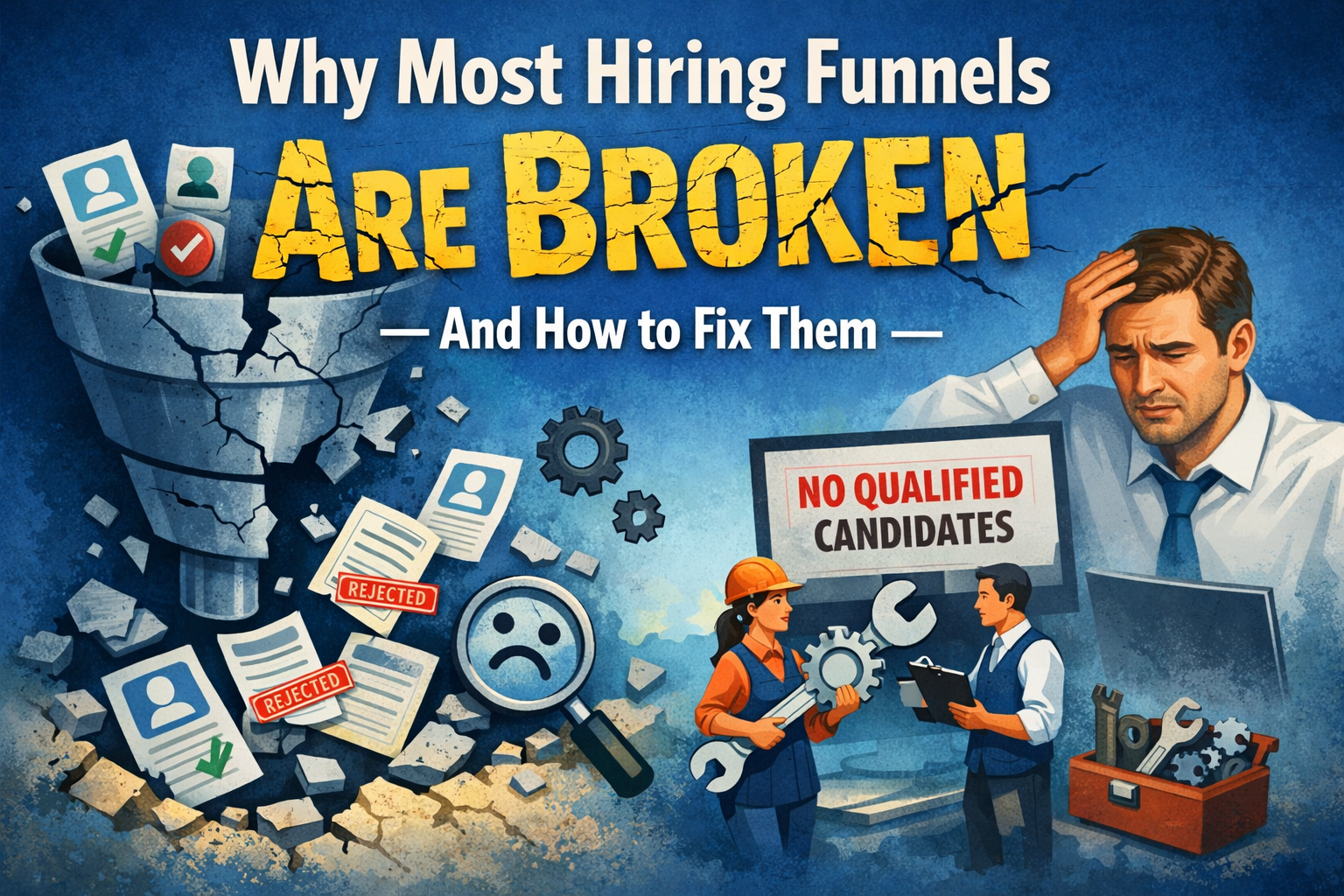
Every organization tracks its hiring funnel.
Applications → Screening → Interviews → Offers → Hires.
On paper, it looks structured. Measurable. Optimized.
But in reality?
Most hiring funnels are fundamentally broken.
Not because companies lack tools or data—but because they optimize for the wrong things, measure the wrong signals, and ignore where the real breakdowns happen.
The result:
- Great candidates drop off
- Hiring cycles drag on
- Quality suffers
- And teams blame “talent shortage” instead of process failure
Let’s unpack what’s actually going wrong—and how to fix it with a more modern, data-driven approach.
The Illusion of a Healthy Funnel
At a glance, most funnels look fine:
- High application volume
- Decent interview pipeline
- Offers going out
But volume hides inefficiency.
Here’s what real data across industries shows:
- Only 10–20% of applicants are actually qualified
- Of those, only 20–30% make it past initial screening
- Interview-to-offer ratios often exceed 5:1 or even 8:1
- Offer acceptance rates hover around 60–75% in competitive markets
That means for every 100 applicants:
- 80–90 were never a fit
- 10–15 were evaluated seriously
- 1–3 actually get hired
This isn’t a funnel.
It’s a leaky pipeline with massive inefficiencies.
Where Hiring Funnels Break Down
1. Top of Funnel: Volume Over Precision
Most organizations still rely heavily on:
- Job boards
- Mass applications
- Generic sourcing
The problem?
More applicants ≠ better candidates.
High-volume funnels create:
- Recruiter overload
- Slower response times
- Poor candidate experience
Data insight:
Companies report that over 70% of applications are irrelevant for specialized roles (especially in tech, product, and niche domains).
What’s broken:
You’re optimizing for quantity, not quality.
2. Screening Stage: Weak Signal Detection
Resume screening remains one of the weakest parts of the funnel.
Why?
- Resumes are optimized for keywords, not capability
- Recruiters rely on heuristics and speed
- Strong candidates often get filtered out
At the same time:
- Underqualified candidates slip through due to keyword matching
Result:
Both false positives and false negatives increase.
3. Interview Stage: Inconsistency and Bias
This is where most funnels lose high-quality candidates.
Common issues:
- Unstructured interviews
- Different interviewers evaluating different things
- No standardized scoring
Data insight:
Unstructured interviews are one of the least predictive hiring methods, while structured interviews improve hiring accuracy by up to 2x.
Add to that:
- Delays between rounds
- Poor interviewer preparedness
- Repetitive questioning
And candidates start dropping out—or worse, disengaging.
4. Decision-Making: Slow and Misaligned
Even after interviews are complete, hiring often stalls due to:
- Too many stakeholders
- Lack of clear decision criteria
- Internal misalignment
Top candidates don’t wait.
In competitive markets:
The best candidates are off the market within 10 days.
Yet many hiring processes take:
- 3–6 weeks (or more)
This gap alone kills conversion rates.
5. Offer Stage: Weak Closing Strategy
Organizations assume that once an offer is rolled out, the job is done.
But data tells a different story:
- 25–40% of offers are declined in competitive roles
- Top reasons include:
- Better competing offers
- Poor candidate experience
- Misaligned expectations
By the time you’re negotiating, it’s often too late to fix earlier mistakes.
The Real Problem: Funnel Optimization Is Misaligned
Most hiring funnels are designed around:
- Internal convenience
- Process compliance
- Volume handling
But not around:
- Candidate behavior
- Decision speed
- Quality signals
That’s why they break.
How to Fix the Hiring Funnel (Step-by-Step)
1. Redesign the Top of Funnel: Precision Sourcing
Shift from:
- “Post and pray” → targeted sourcing
Focus on:
- Talent communities (Slack, Discord, GitHub, niche forums)
- Employee referrals (often highest quality hires)
- Direct sourcing for critical roles
Data insight:
Referrals typically have:
- 2–4x higher conversion rates
- Better retention and performance
Goal: Reduce noise. Increase signal.
2. Replace Resume Screening with Skill-Based Filters
Move beyond resumes.
Introduce:
- Work sample tests
- Short problem-solving tasks
- Role-specific assessments
Why this works:
Candidates demonstrate actual capability, not just experience.
Result:
- Better shortlisting accuracy
- Reduced bias
- Stronger candidate-job fit
3. Structure the Interview Process
Standardization is key.
Implement:
- Defined competencies per role
- Consistent questions across candidates
- Clear scoring rubrics
This ensures:
- Fair comparison
- Better decision-making
- Reduced interviewer bias
Also:
Train hiring managers—because interview quality directly impacts hiring quality.
4. Compress Time-to-Decision
Speed is a competitive advantage.
Fix this by:
- Limiting interview rounds (3–4 max)
- Scheduling all rounds upfront
- Aligning decision-makers early
Data insight:
Reducing hiring cycle time by even 20–30% significantly improves offer acceptance rates.
5. Build a Strong Candidate Experience
Every touchpoint matters:
- Communication speed
- Interview quality
- Transparency
Candidates evaluate you as much as you evaluate them.
Poor experience leads to:
- Drop-offs
- Offer declines
- Negative employer brand impact
6. Treat Offers as a Sales Process
Closing matters.
Best practices:
- Understand candidate motivations early
- Benchmark compensation in real time
- Keep candidates warm throughout the process
Top recruiters act like consultative sellers, not process coordinators.
7. Track the Right Metrics
Most teams track:
- Time-to-fill
- Cost-per-hire
But to fix the funnel, you need deeper insights:
Track:
- Stage-wise conversion rates
- Drop-off reasons
- Source-to-quality ratio
- Interview-to-offer ratio
- Offer acceptance rate
And most importantly:
- Quality of Hire (post-hire success)
What High-Performing Hiring Funnels Look Like
Organizations that get this right:
✔ Source proactively instead of relying on inbound volume
✔ Use skill-based screening methods
✔ Run structured, consistent interviews
✔ Make fast, aligned decisions
✔ Deliver strong candidate experiences
✔ Continuously optimize using data
Their funnels are not bigger.
They’re sharper.
The Shift: From Funnel to Hiring Engine
The biggest mindset change is this:
Stop thinking of hiring as a funnel.
Start thinking of it as a conversion engine.
Because hiring is not just about filtering candidates—it’s about:
- Attracting the right talent
- Assessing them effectively
- Converting them quickly
Final Thought
Most hiring funnels aren’t broken because of lack of effort.
They’re broken because they were designed for a different era—
when talent was abundant, competition was lower, and speed didn’t matter as much.
That world no longer exists.
Today:
- Candidates have more choices
- Skills are more specialized
- And delays are more costly
The organizations that win won’t be the ones with the biggest funnels.
They’ll be the ones with the most efficient, data-driven, and candidate-centric hiring engines.
Because in the end:
Hiring is not a volume game.
It’s a precision game.
Learn Real-World Sourcing Strategies
At AshimHub, we help freshers and early recruiters move beyond basic hiring processes and develop real-world sourcing expertise.
Our structured coaching focuses on:
- Multi-channel sourcing strategies
- Passive candidate engagement
- Practical hiring workflows
- Real-world recruitment challenges
If you want to build a strong foundation in recruitment, start by mastering the channels that actually deliver results.
 Explore AshimHub coaching and become a recruiter who knows where and how to find the right talent.
Explore more – www.ashimhub.com