

Introduction
For many freshers entering recruitment, job portals seem like the center of the hiring universe.
Post a job. Receive applications. Screen resumes. Move candidates forward.
Simple. Efficient. Familiar.
But in real-world hiring, this approach quickly reaches its limits.
Job portals are just one sourcing channel—and often the most crowded and competitive one. The reality is that the best candidates are not always applying. Many are already employed, engaged in their roles, and invisible to traditional job postings.
This is where strong recruiters differentiate themselves.
They don’t rely on job portals alone. They explore, experiment, and build strategies across multiple sourcing channels to find the right talent—not just available talent.
Understanding these channels is not optional. It is a core capability that determines how effective a recruiter becomes.
Why Job Portals Alone Are Not Enough
Job portals serve an important purpose, but they come with clear limitations:
- High volume of irrelevant applications
- Limited access to passive candidates
- Increased competition from other recruiters
- Overdependence leading to slower hiring cycles
When recruiters rely only on job portals, they operate within a restricted talent pool.
This leads to:
- Lower quality matches
- Longer time-to-hire
- Frustrated hiring managers
To overcome this, recruiters must expand their sourcing strategy.
The Shift: From Passive Sourcing to Active Talent Discovery
Modern recruitment requires a shift in mindset:
From:
- Waiting for candidates to apply
- Filtering large volumes of resumes
To:
- Identifying where talent exists
- Engaging candidates proactively
- Building long-term pipelines
Recruitment becomes less about processing and more about market intelligence and relationship building.
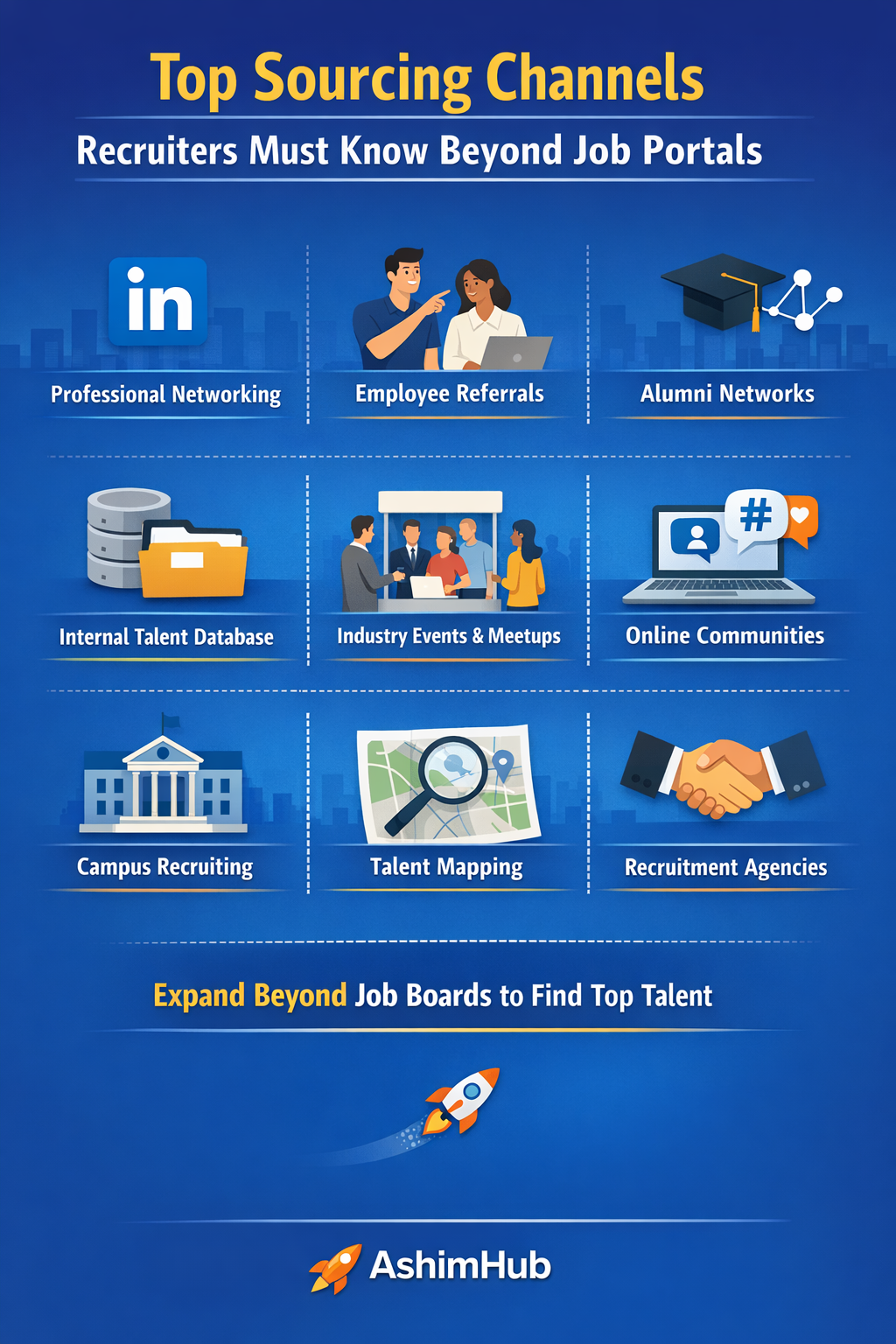
1. Professional Networking Platforms
Professional platforms like LinkedIn are among the most powerful sourcing channels available today.
But simply searching is not enough.
Strong recruiters use these platforms to:
- Identify career progression patterns
- Analyze skills and endorsements
- Understand industry positioning
- Track candidate activity and engagement
Why It Works
- Access to both active and passive candidates
- Advanced search and filtering capabilities
- Direct communication with candidates
Real-World Insight
Top recruiters don’t just search—they map talent pools. They identify clusters of professionals in specific roles, companies, or industries and build targeted outreach strategies.
2. Employee Referrals
Employee referrals remain one of the most effective sourcing channels—yet often underutilized.
Your existing employees are connected to:
- Former colleagues
- Industry peers
- Trusted professionals
Why It Works
- Higher quality candidates
- Faster hiring cycles
- Better cultural alignment
Strategic Approach
Instead of passively waiting for referrals, recruiters should:
- Actively request referrals for specific roles
- Clearly communicate role requirements
- Recognize and reward successful referrals
Referrals are not just a channel—they are a trust-based sourcing mechanism.
3. Alumni Networks
Alumni networks—both academic and organizational—are valuable but often overlooked.
These networks provide access to:
- Pre-vetted professionals
- Shared educational or work backgrounds
- Strong community-driven connections
Why It Works
- Built-in credibility and trust
- Easier engagement due to shared identity
- Strong response rates
Real-World Application
Recruiters hiring for niche roles often tap into alumni groups to find candidates with specific educational backgrounds or skill sets.
4. Internal Talent Databases
One of the most underused assets in recruitment is the internal candidate database.
These include:
- Previous applicants
- Silver medalists (strong candidates who were not selected)
- Past interviewees
Why It Works
- Candidates are already familiar with your organization
- Reduced sourcing time
- Higher engagement likelihood
Strategic Insight
Strong recruiters maintain organized databases and revisit them regularly.
Instead of starting from scratch, they leverage existing talent pools.
5. Industry Communities and Forums
Communities—both online and offline—are powerful sources of engaged talent.
These include:
- Professional forums
- Slack/Discord groups
- Industry meetups
- Technical communities
Why It Works
- Access to highly engaged professionals
- Insight into candidate expertise and interests
- Opportunity to observe contributions and thought leadership
Example
Developers active in GitHub or tech communities often showcase real work, making it easier to assess capability beyond resumes.
6. Social Media Platforms
Beyond LinkedIn, platforms like Twitter (X), Instagram, and even YouTube are emerging sourcing channels.
Professionals often:
- Share insights
- Build personal brands
- Engage in industry discussions
Why It Works
- Reveals personality and communication style
- Provides deeper context beyond resumes
- Enables informal engagement
Strategic Use
Recruiters can identify thought leaders, content creators, and domain experts through consistent online presence.
7. Recruitment Events and Meetups
Events such as:
- Career fairs
- Industry conferences
- Networking meetups
offer direct access to talent.
Why It Works
- Face-to-face interaction builds stronger connections
- Immediate assessment of communication and interest
- Opportunity to build employer brand
Real-World Insight
Recruiters who actively participate in events often build long-term talent pipelines, not just immediate hires.
8. Campus Hiring and Early Talent Programs
For entry-level roles, campuses are a critical sourcing channel.
Why It Works
- Access to fresh talent
- Opportunity to shape early careers
- Strong employer branding impact
Strategic Approach
- Build relationships with institutions
- Conduct workshops and engagement sessions
- Create structured hiring programs
9. Recruitment Agencies and External Partners
For niche or urgent roles, agencies can provide access to specialized talent pools.
Why It Works
- Faster access to pre-screened candidates
- Expertise in specific industries
- Ability to scale quickly
Caution
This should complement—not replace—internal sourcing capabilities.
10. Talent Mapping and Market Research
One of the most advanced sourcing strategies is talent mapping.
This involves:
- Identifying target companies
- Mapping key roles and professionals
- Understanding talent distribution
Why It Works
- Provides a structured view of the talent market
- Enables proactive hiring
- Reduces dependency on reactive sourcing
Choosing the Right Channel
Not all channels work equally for every role.
Recruiters must evaluate:
- Role complexity
- Industry
- Urgency
- Candidate availability
For example:
- Tech roles → communities + LinkedIn
- Leadership roles → referrals + headhunting
- Entry-level roles → campuses + job portals
The key is channel alignment with hiring needs.
Common Mistakes to Avoid
1. Over-Reliance on One Channel
Limits access to diverse talent pools.
2. Lack of Strategy
Using channels without clear targeting reduces effectiveness.
3. Ignoring Passive Candidates
Misses high-quality talent.
4. Poor Follow-Up
Even strong sourcing fails without consistent engagement.
Building a Multi-Channel Sourcing Strategy
Strong recruiters combine multiple channels.
A balanced strategy includes:
- Job portals for active candidates
- LinkedIn for passive sourcing
- Referrals for quality hires
- Communities for niche talent
- Databases for efficiency
This creates a sustainable sourcing ecosystem.
The Strategic Advantage
Recruiters who master multiple sourcing channels:
- Access better talent
- Reduce time-to-hire
- Improve hiring quality
- Build strong pipelines
- Gain trust from hiring managers
They move from:
Reactive hiring → Strategic talent acquisition
Final Thoughts
Job portals may bring volume—but diverse sourcing channels bring quality.
Recruitment success depends not on how many resumes you receive, but on how effectively you find and engage the right talent.
Understanding and leveraging multiple sourcing channels is what separates average recruiters from high-performing ones.
Learn Real-World Sourcing Strategies
At AshimHub, we help freshers and early recruiters move beyond basic hiring processes and develop real-world sourcing expertise.
Our structured coaching focuses on:
- Multi-channel sourcing strategies
- Passive candidate engagement
- Practical hiring workflows
- Real-world recruitment challenges
If you want to build a strong foundation in recruitment, start by mastering the channels that actually deliver results.
🚀 Explore AshimHub coaching and become a recruiter who knows where and how to find the right talent.