

Introduction
One of the biggest misconceptions in recruitment is that the best candidates are actively searching for jobs.
In reality, the opposite is often true.
The most skilled, high-performing professionals are usually not actively job hunting. They are already employed, engaged in meaningful work, and focused on growth within their current organizations. They are not scrolling through job portals or applying to multiple roles—they are building their careers.
This creates a critical challenge for recruiters:
How do you find and engage talent that isn’t looking for you?
The answer lies in mastering the strategy of sourcing passive candidates.
Recruiters who develop this capability gain access to a hidden talent market—one that consistently delivers higher-quality hires, stronger retention, and better long-term outcomes.
Who Are Passive Candidates?
Passive candidates are professionals who:
- Are currently employed
- Are not actively applying for jobs
- Are open to opportunities if approached the right way
They are typically:
- High performers in their current roles
- Selective about career decisions
- Motivated by growth, impact, and alignment—not urgency
Unlike active candidates, passive candidates require intentional engagement. They don’t respond to generic outreach—they respond to relevance, credibility, and value.
Why Passive Candidates Matter More Than Ever
In today’s competitive hiring environment, relying only on active candidates limits your success.
1. Access to Top Talent
Passive candidates are often already excelling in their roles. They bring proven experience and real-world impact.
2. Better Long-Term Fit
They make career moves based on thoughtful decisions, which often leads to better alignment and retention.
3. Reduced Competition
Fewer recruiters actively target passive candidates effectively, giving you a strategic edge.
4. Stronger Hiring Outcomes
Because they are not desperate for change, passive candidates evaluate opportunities more carefully—leading to better hiring decisions.
The Mindset Shift: From Waiting to Finding
To succeed in sourcing passive candidates, recruiters must shift their mindset:
From:
- Waiting for applications
- Screening resumes
- Reacting to demand
To:
- Identifying target talent
- Understanding career journeys
- Engaging candidates proactively
Recruitment becomes less about processing and more about discovery and influence.
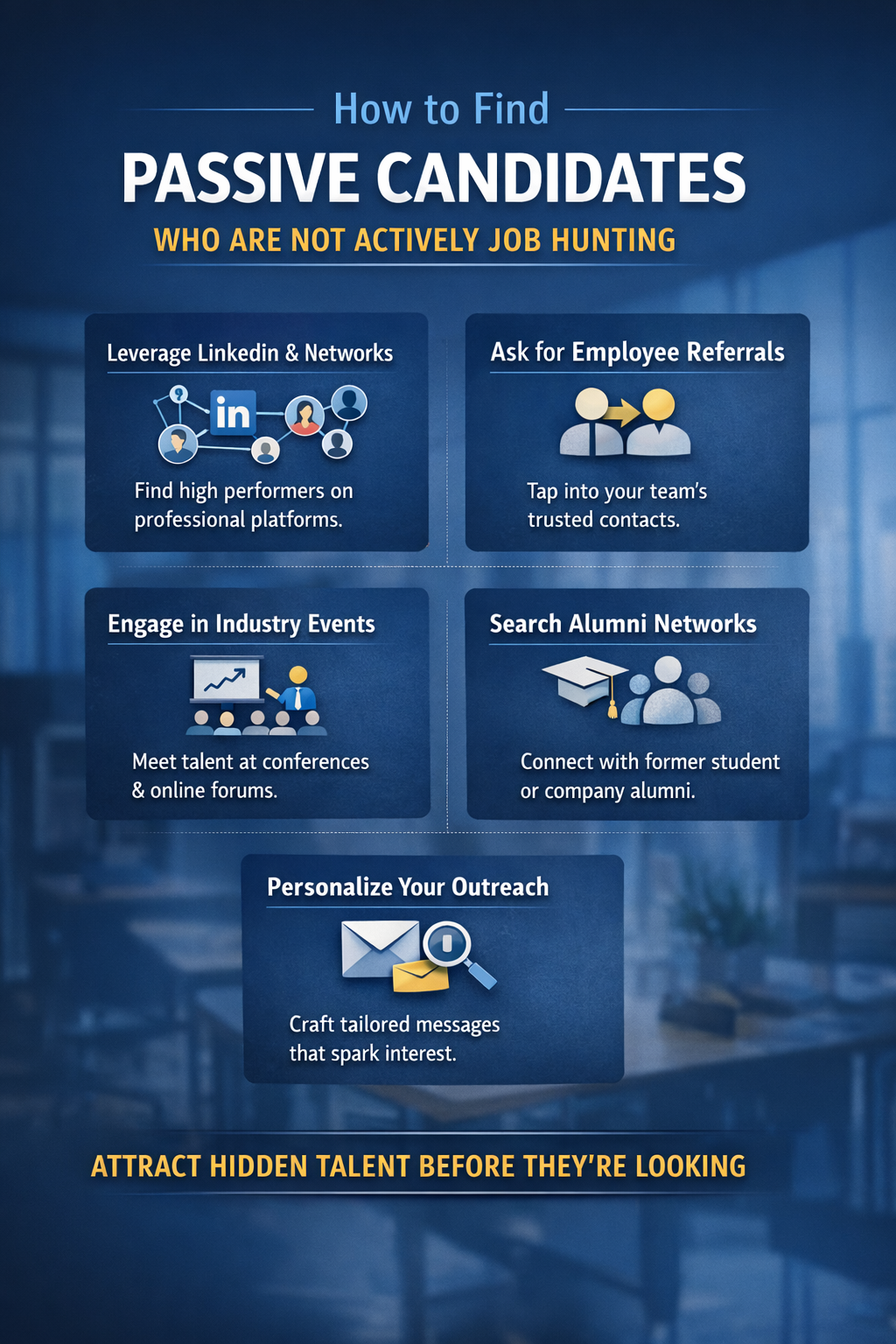
Where to Find Passive Candidates
Passive candidates are not absent—they are simply not applying. The key is knowing where to look.
1. Professional Platforms
Platforms like LinkedIn are the most powerful sourcing tools.
Look for:
- Career progression
- Relevant skills and endorsements
- Industry engagement
Strong recruiters don’t just scan profiles—they interpret them.
2. Employee Referrals
Your internal team can be one of your strongest sourcing channels.
Employees often know:
- Skilled professionals in their network
- Former colleagues
- Trusted industry connections
Referral candidates often come with built-in credibility.
3. Alumni Networks
University and company alumni groups provide access to reliable and relevant talent pools.
These networks are especially useful for:
- Early-career hiring
- Specialized roles
- Industry-specific hiring
4. Industry Communities
Communities, forums, and professional groups are goldmines for passive talent.
Here you can identify:
- Thought leaders
- Active contributors
- Passionate professionals
5. Internal Databases
Past candidates who were not selected can still be strong fits for new roles.
Re-engaging them saves time and improves efficiency.
How to Identify the Right Passive Candidates
Sourcing is not about finding more people—it’s about finding the right people.
Focus on:
1. Career Growth
Look for consistent progression and increasing responsibility.
2. Skill Relevance
Focus on transferable skills rather than exact matches.
3. Impact
Look for measurable achievements and contributions.
4. Stability vs Change
Understand patterns in job movement to assess motivation.
Strong recruiters think beyond titles—they evaluate potential and trajectory.
The Art of First Outreach
The first message determines whether a passive candidate engages or ignores you.
Generic messages fail because they lack relevance.
Weak Message:
“Urgent opening. Share your resume.”
Strong Message:
“I came across your experience in [specific skill/project], and it aligns with a challenge we’re currently solving. I’d love to explore if this could be relevant for you—open to a quick conversation?”
A strong outreach message should:
- Be personalized
- Show clear intent
- Connect candidate experience with the role
- Invite, not pressure
Passive candidates respond to thoughtfulness, not urgency.
Building Interest Before Selling
Passive candidates are not looking for jobs—they are evaluating opportunities.
This means recruiters must focus on:
- Growth potential
- Learning opportunities
- Role impact
- Team and leadership quality
Instead of pushing the job, create curiosity.
Your goal is not to close immediately—it is to start a meaningful conversation.
Building Long-Term Relationships
Not every passive candidate will convert immediately.
Strong recruiters understand this and invest in long-term relationships.
They:
- Stay in touch periodically
- Share relevant opportunities
- Provide industry insights
- Maintain structured records
Over time, this builds a talent pipeline that reduces sourcing effort and improves hiring efficiency.
Common Mistakes to Avoid
1. Mass Messaging
Generic outreach reduces response rates and damages credibility.
2. Over-Selling
Being too aggressive can push candidates away.
3. Lack of Research
Poor understanding leads to irrelevant communication.
4. Ignoring Timing
A “no” today can become a “yes” later.
How Freshers Can Build This Skill
Passive sourcing improves with practice.
Start with:
- Learning Boolean search techniques
- Studying strong professional profiles
- Practicing personalized outreach
- Tracking response rates
- Seeking feedback
Over time, you’ll develop:
- Better targeting ability
- Stronger messaging
- Higher engagement rates
The Strategic Advantage
Recruiters who master passive sourcing:
- Fill roles faster
- Access better talent
- Reduce dependency on job portals
- Build strong pipelines
- Gain stakeholder trust
They move from:
Executor → Talent Strategist
Final Thoughts
Finding passive candidates is not just a sourcing tactic—it is a core recruitment capability.
It requires:
- Curiosity to explore beyond obvious channels
- Discipline to research and personalize
- Patience to build relationships
- Judgment to identify potential
Recruiters who master this don’t wait for talent.
They find, engage, and attract the right people before others even reach them.
Learn Practical Sourcing Skills
At AshimHub, we help freshers move beyond basic recruitment tasks and build real-world sourcing expertise.
Our structured coaching helps you:
- Master passive candidate sourcing
- Write high-conversion outreach messages
- Build long-term talent pipelines
- Handle real hiring challenges confidently
If you want to stand out in recruitment, start by mastering the skill that truly differentiates great recruiters.
🚀 Explore AshimHub coaching and become a recruiter who doesn’t just hire—but discovers and attracts top talent.