

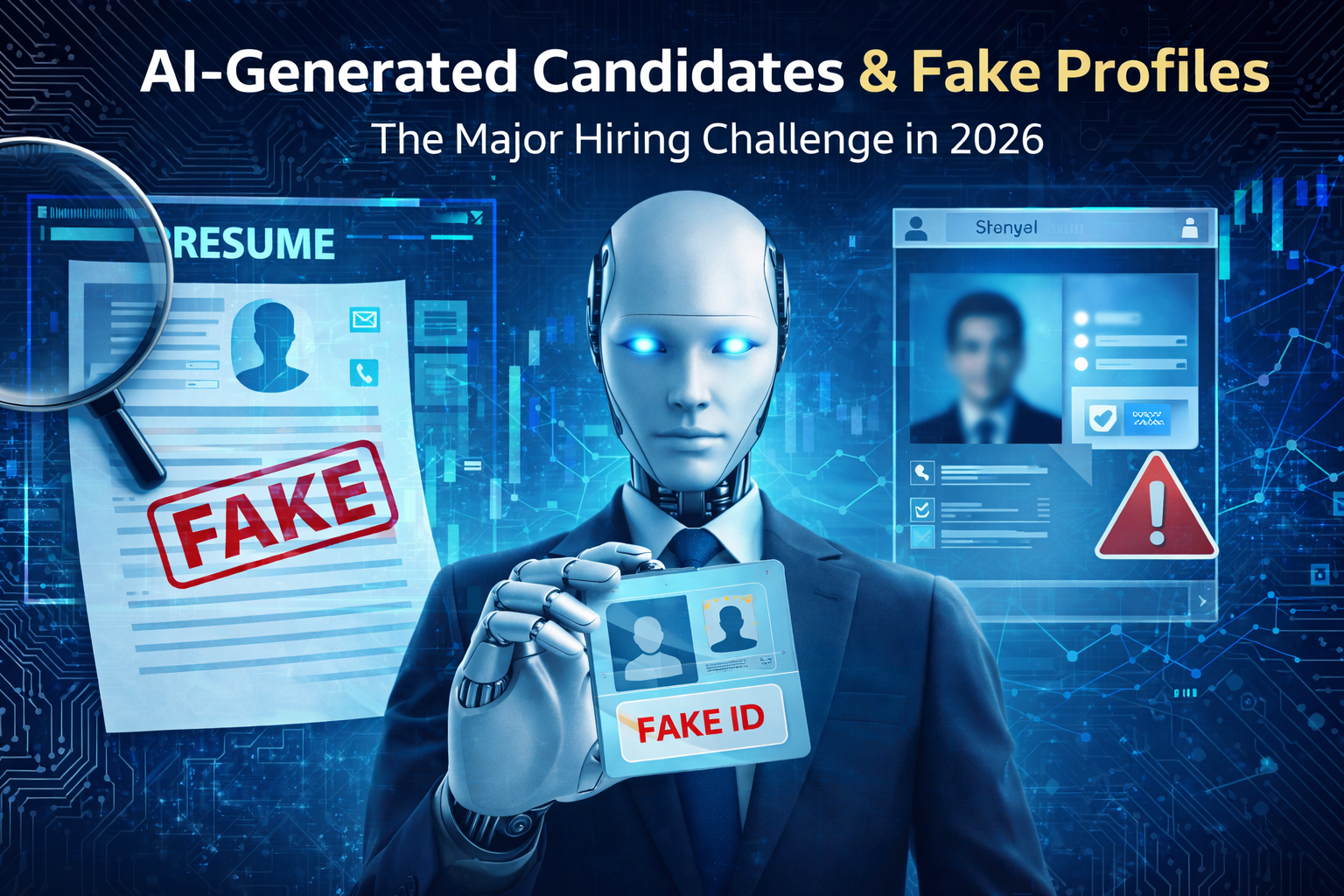
AI-Generated Candidates & Fake Profiles: The Major Recruitment Challenge of 2026
Introduction
Artificial Intelligence is transforming recruitment at an unprecedented pace. From automated resume screening to AI-powered interviews, organizations are hiring faster and more efficiently than ever before. However, alongside these benefits, a new and serious challenge has emerged in 2026: AI-generated candidates and fake professional profiles.
Recruiters today are increasingly encountering resumes, portfolios, and even interview responses created entirely or partially using AI tools. These profiles often appear highly polished, technically sound, and convincing. Yet in many cases, they misrepresent the candidate’s real capabilities.
This trend is becoming one of the most critical risks in modern talent acquisition, affecting hiring quality, organizational productivity, and business security.
What Are AI-Generated Candidates?
AI-generated candidates refer to individuals who use artificial intelligence tools to create or significantly enhance their professional identity beyond their actual qualifications or experience.
This may include:
- AI-generated resumes tailored perfectly to job descriptions
- Automatically generated cover letters
- Fake project portfolios created using AI tools
- AI-assisted interview responses in real time
- Synthetic identities using fake photos, credentials, or employment history
While using AI tools for assistance is not inherently wrong, the issue arises when AI is used to misrepresent skills, fabricate experience, or deceive employers.
Why This Problem Has Increased in 2026
Several technological and market factors have accelerated this challenge.
1. Easy Access to Advanced AI Tools
AI platforms can now generate professional resumes, coding samples, and project explanations within seconds. These outputs often appear credible even to experienced recruiters.
2. Remote Hiring and Global Talent Pools
Remote hiring has expanded access to global candidates. While beneficial, it also makes identity and skill verification more difficult.
3. Competitive Job Market
With more candidates competing for fewer roles in certain industries, some individuals use AI tools to improve their chances artificially.
4. Automated Hiring Systems
Many organizations rely on Applicant Tracking Systems (ATS) and AI screening tools, which can be manipulated using optimized, AI-generated resumes.
Types of Fake Profiles Recruiters Are Encountering
1. Fully Fabricated Candidates
These profiles may include fake names, AI-generated photos, and false credentials. In some cases, these identities are used for fraud or corporate espionage.
2. Skill-Inflated Candidates
Real individuals exaggerate or falsely claim advanced skills using AI-generated project descriptions or technical explanations.
3. AI-Assisted Interview Manipulation
Candidates may use AI tools during online interviews to generate real-time answers, giving the impression of deeper expertise.
4. Fake Freelancers and Remote Workers
Some profiles represent individuals who outsource their work entirely to others after getting hired.
Risks for Organizations
Hiring AI-generated or fake candidates can have serious consequences.
Productivity Loss
Employees who lack genuine skills may fail to perform required tasks, slowing down projects and teams.
Financial Costs
Recruitment, onboarding, and training require significant investment. Hiring the wrong candidate increases replacement costs.
Security Threats
Fake candidates may attempt to gain access to sensitive company systems, data, or intellectual property.
Damage to Team Performance
Poor hiring decisions can reduce team efficiency and affect overall morale.
How Recruiters Can Identify Fake or AI-Generated Candidates
Organizations must adopt stronger verification and evaluation methods.
1. Conduct Skill-Based Assessments
Practical tests help evaluate real capabilities rather than relying solely on resumes.
Examples include:
- Coding challenges
- Case studies
- Live problem-solving exercises
- Role-specific assignments
2. Use Structured Interviews
Structured interviews with deeper follow-up questions make it harder for candidates to rely entirely on AI assistance.
3. Verify Professional History
Employers should verify:
- Previous employment
- Educational qualifications
- Certifications
- Project experience
4. Look for Inconsistencies
Warning signs may include:
- Overly perfect resumes
- Lack of detailed explanations
- Inconsistent career timelines
- Difficulty explaining projects in depth
5. Conduct Live Demonstrations
Ask candidates to demonstrate their skills in real time without preparation.
How AI Is Also Helping Solve This Problem
Interestingly, AI is also part of the solution.
AI-Powered Verification Tools
Advanced AI systems can analyze:
- Resume authenticity
- Behavioral patterns
- Interview responses
- Identity verification
Skill Validation Platforms
Online assessment platforms help objectively evaluate candidate skills.
Fraud Detection Systems
AI systems can detect suspicious profiles and unusual hiring patterns.
The Shift Toward Skills-Based Hiring
This challenge is accelerating the shift toward skills-based hiring, where organizations focus more on proven abilities than credentials alone.
Instead of relying only on resumes, companies are prioritizing:
- Practical assessments
- Real-world problem solving
- Verified portfolios
- Demonstrated competencies
This approach improves hiring accuracy and reduces risks associated with fake profiles.
Best Practices for Organizations in 2026
To protect hiring quality, organizations should implement the following strategies:
Strengthen Verification Processes
Verify identity, employment history, and qualifications carefully.
Use Multi-Stage Assessments
Combine technical tests, interviews, and practical assignments.
Train Recruiters
Recruiters must be trained to recognize AI-generated patterns and inconsistencies.
Implement Secure Hiring Systems
Use trusted hiring platforms and verification tools.
Focus on Real Skills
Prioritize demonstrated capabilities over resume presentation quality.
Ethical Use of AI in Job Applications
It is important to recognize that AI can be used ethically in job applications. Acceptable uses include:
- Improving resume clarity
- Correcting grammar
- Preparing for interviews
- Learning new skills
The problem arises only when AI is used to misrepresent qualifications or deceive employers.
Transparency and honesty remain essential for building trust between candidates and organizations.
The Future of Recruitment
AI will continue to play a major role in recruitment. However, the focus will shift toward:
- Verified skills over credentials
- Authentic candidate evaluation
- Stronger identity verification
- Human-AI collaboration in hiring
Organizations that adapt to these changes will build stronger, more reliable teams.
Conclusion
AI-generated candidates and fake profiles represent one of the biggest recruitment challenges of 2026. While AI has improved hiring efficiency, it has also created new risks related to authenticity and trust.
To address this issue, organizations must adopt skills-based hiring, strengthen verification processes, and use advanced assessment methods.
The future of recruitment will depend on balancing AI efficiency with human judgment and skill validation. Companies that focus on authenticity, verified capabilities, and ethical hiring practices will be best positioned for long-term success.
URL Slug:
ai-generated-candidates-fake-profiles-recruitment-2026
FAQ
Q1: What are AI-generated candidates?
AI-generated candidates are individuals who use artificial intelligence tools to create resumes, portfolios, or interview responses that may not accurately reflect their real skills.
Q2: Why is this a major challenge in 2026?
Advanced AI tools make it easier to create convincing fake profiles, increasing risks for recruiters and organizations.
Q3: How can companies prevent fake hiring?
Companies can use skill assessments, identity verification, structured interviews, and AI-powered fraud detection tools.
Q4: Is using AI for resumes unethical?
Using AI for improving clarity or formatting is acceptable, but misrepresenting skills or experience is unethical.
Q5: What is the future solution?
Skills-based hiring and verified assessments will become the primary methods for ensuring authentic recruitment.
About the Author
Ashish Kumar Bhowmick is the founder of AshimHub, a platform dedicated to exploring technology, AI tools, gadgets, and emerging digital trends. With a strong passion for simplifying complex technologies, he creates practical guides, product comparisons, and tutorials that help readers make smarter technology decisions.
Alongside his work in technology content, Ashish has professional experience in talent acquisition and recruitment coaching. He has supported organizations and professionals in improving hiring strategies, building stronger recruitment processes, and developing career growth pathways in competitive job markets.
Through AshimHub, Ashish combines technology insights with professional expertise, delivering valuable content that empowers both tech enthusiasts and career-focused readers. His mission is to make technology and professional development more accessible, practical, and easy to understand for everyday users.
Connect with him on LinkedIn:
https://www.linkedin.com/in/ashish-bhowmick-42961311/